I Analyzed 3,000 Viral TikToks. The #fyp Hashtag Does Basically Nothing.
Every TikTok "growth guide" says the same thing: stack your captions with #fyp #foryou #viral and pray the algorithm picks you up. I'd done it on every video for months. So had everyone I knew. And none of us could actually say whether it worked, we just kept doing it because everyone else did.
So I decided to stop guessing and look at the data.
I pulled ~3,000 high-performing TikToks, tracked their views and engagement, and ran each one through frame-by-frame analysis using fypnow.com to see what actually separated the videos that took off from the ones that didn't. I expected the hashtags to matter at least a little!
They didn't. Here's what the data showed.
Do TikTok hashtags actually work?
Short answer: partly. Using 1–3 relevant hashtags gives a small lift (~18% higher median views than none), but generic tags like #fyp, #foryou, and #viral make no measurable difference, and stacking 7+ hashtags actively lowers reach. Hashtags are a weak signal — TikTok rewards retention far more, so your first two seconds matter more than any tag. (For the full approach, see our TikTok hashtag strategy guide.)1. #fyp made no measurable difference to reach
This was the first surprise. I split the videos into two groups: those using #fyp (and its cousins, #foryou, #viral) and those that skipped them entirely, and compared the median views of each.
The videos without #fyp actually had about 5% higher median views.
Not lower. Higher. The gap is small enough to be noise, but the point is: if #fyp were the magic reach button everyone claims, this comparison across more than a thousand videos that don't use it would show an obvious advantage. It doesn't. The hashtag everyone swears by simply doesn't move the needle.
2. A few hashtags help. Stacking them backfires.
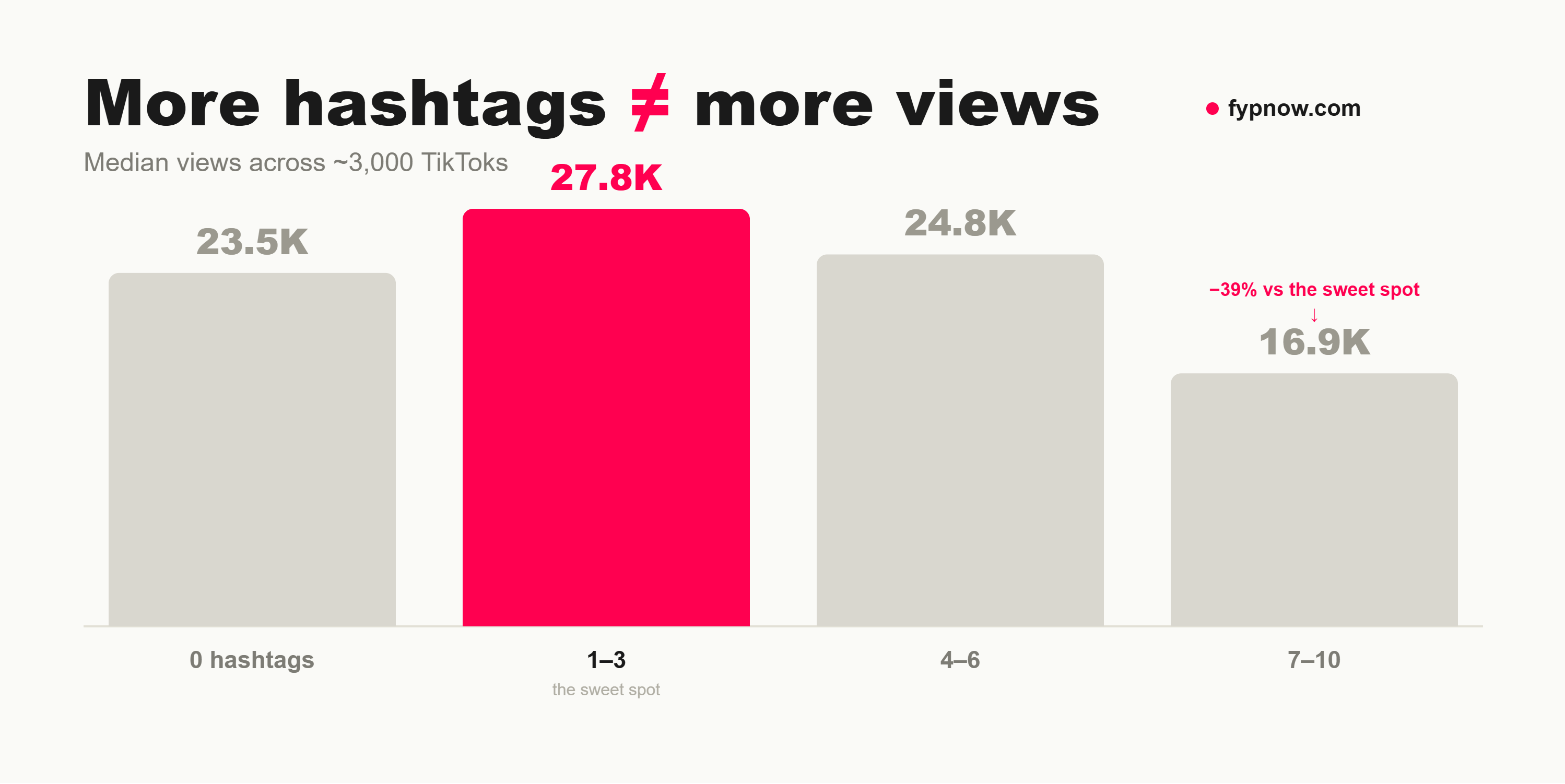
So hashtags are useless? Not quite. The story is more interesting. When I grouped videos by how many hashtags they used, a clear pattern showed up:
- 1–3 hashtags was the sweet spot (about 18% higher median views than using none at all).
- 4–6 hashtags — roughly flat. No real benefit.
- 7–10 hashtags — about 39% lower median views than the 1–3 group, and ~28% below using no hashtags at all.
Piling on hashtags didn't just stop helping, but it actively correlated with fewer views. A handful of relevant tags gives the system a little context. A wall of them looks like exactly what it is, someone trying to game distribution, and the performance drops off a cliff.
The "more hashtags = more reach" instinct is backwards.
3. Here's what actually predicted views: your first two seconds
If hashtags barely matter, what does? This is where the frame-by-frame analysis paid off.
The single strongest correlation with views wasn't a hashtag, a sound, or a posting time. It was how fast the opening hook landed.
Videos that resolved their hook in 2.1 seconds or less got about 30% higher median views than slower ones.
That makes sense when you think about how the platform works. TikTok doesn't reward hashtags, it rewards retention. Every second someone keeps watching is a vote that your video deserves more distribution. Hashtags are a weak, easily-gamed signal. Whether a real human stops scrolling in the first two seconds is a strong one. The algorithm trusts the second far more than the first.
You can spend an hour researching the perfect hashtags. Or you can spend that hour making your first two seconds impossible to scroll past. The data is brutally clear about which one pays off.
What to actually do with this
- Drop the hashtag obsession. Use 1–3 relevant, specific tags — our hashtag generator builds a focused set for your niche. Skip the #fyp #foryou #viral wall — at best it does nothing, at worst it costs you.
- Put the saved effort into your hook. Open with the payoff, the tension, or the promise. Aim to land it inside ~2 seconds.
- Study what already works in your niche. The fastest way to fix your hooks is to break down videos that overperformed and copy the mechanics, not the topic.
Frequently asked questions
Do TikTok hashtags actually work?
Partly. Using 1 to 3 relevant hashtags gave about 18% higher median views than using none, but generic tags like #fyp, #foryou, and #viral made no measurable difference. Stacking 7 or more hashtags actively lowered reach.
Does the #fyp hashtag help you go viral?
No. In an analysis of roughly 3,000 high-performing videos, those without #fyp had about 5% higher median views than those using it. The hashtag everyone swears by does not move the needle.
How many hashtags should I use on TikTok?
Use 1 to 3 relevant, specific tags. That range gave the biggest lift in the data, while 7 to 10 hashtags correlated with about 39% lower median views than the 1 to 3 group.
If hashtags barely matter, what does?
Your first two seconds. Videos that resolved their opening hook in 2.1 seconds or less got about 30% higher median views, because TikTok rewards retention far more than tags.
Start free trial
See why any TikTok or YouTube Short went viral with a frame-by-frame AI breakdown. 7-day free trial, then plans from $19/mo.
Prefer to explore first? Start free trial